Petrology
Precambrian Shield Rock Types: Granite, Gneiss, Greenstone, and Anorthosite
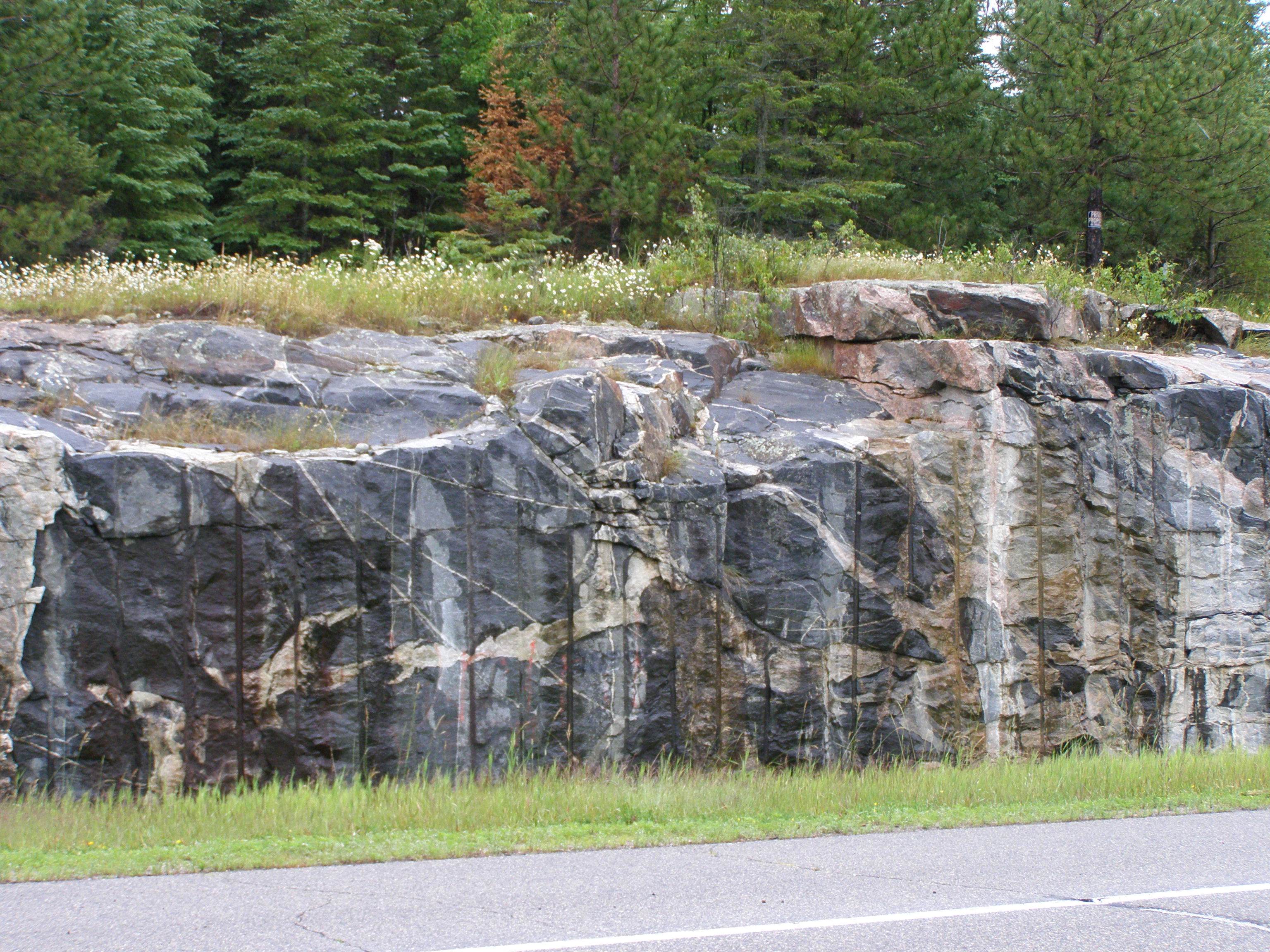
The Canadian Shield covers roughly 4.8 million km² of exposed Precambrian bedrock, with additional basement rock hidden under younger sedimentary cover to the south and west. Four lithological groups dominate the surface geology: granites and related intrusive rocks, high-grade metamorphic gneisses, Archean greenstone sequences, and the less common but scientifically important anorthosites. Each group formed through a distinct set of processes and carries its own record of early Earth history.
Granite and Granitoid Intrusions
Granitic rocks are the most abundant rock type across the Shield, making up large portions of the Superior, Slave, and Churchill provinces. They formed as magma cooled slowly at depth — typically at 10–30 km below the ancient surface — between roughly 2.5 and 2.7 billion years ago during the Neoarchean. The characteristic pale grey or pink colour comes from feldspar; the black speckling from biotite or hornblende.
Granite bodies (technically batholiths when they exceed 100 km²) tend to be structurally massive with low permeability. That property has made certain Shield granites targets for geological repository studies. The Lac du Bonnet Batholith in Manitoba, for example, was the focus of Canada's Underground Research Laboratory project through the 1980s and 1990s, where researchers measured fracture frequency and groundwater flux at depths of 240–420 m.
- Lac du Bonnet Batholith (Manitoba) — 2.64 Ga, pink leucogranite
- Kenora Batholith (Ontario) — classic grey tonalite–trondhjemite–granodiorite (TTG) suite
- Athabasca Granite (Saskatchewan) — associated with unconformity-type uranium deposits
Gneiss Terranes
Where granite and other crustal rocks were buried deeply and subjected to high temperatures and pressures, the original minerals recrystallised into alternating bands of light (feldspar-quartz) and dark (biotite-amphibole) layers. The result is a gneiss — often visually striking but harder to interpret structurally because multiple deformation events overprint one another.
Some of the oldest rocks on Earth are Shield gneisses. The Acasta Gneiss in the Northwest Territories, part of the Slave Province, has yielded zircon ages of 4.031 billion years — making it the oldest known intact crustal rock. The Nain Province in Labrador contains the Uivak Gneiss at roughly 3.7–3.8 Ga. These ages place both within the Hadean–Eoarchean boundary and provide direct evidence of what early continental crust looked like before plate tectonics was fully established.
Gneiss terranes tend to form the core or infrastructure of Archean cratons — the stable, cold roots of old continents that resist subsequent deformation. That rigidity explains why the Shield has remained broadly intact for billions of years despite repeated orogenic events around its margins.

Greenstone Belts
Greenstone belts are elongated, synclinal sequences of Archean volcanic and sedimentary rock that were caught between growing granite-gneiss domes. They are called "greenstone" because metamorphism converts the original basalt and komatiite to chlorite and epidote — green-coloured minerals. The belts are typically 50–300 km long, a few tens of kilometres wide, and Neoarchean in age (2.7–2.5 Ga), though some in the Slave Province are as old as 3.2 Ga.
Economically, greenstone belts are critical. The komatiitic and tholeiitic volcanic sequences host nickel sulphide deposits (particularly associated with ultramafic flows), while shear zones cutting through the belts carry orogenic gold deposits. The Abitibi Greenstone Belt, which straddles the Ontario-Quebec border, is the single most productive Archean terrane in Canadian mining history.
Beyond their economic significance, greenstone belts provide evidence for early plate-like behaviour. The volcanic rocks show geochemical signatures — particularly their komatiite compositions — that require source temperatures 200–300°C hotter than modern mantle, consistent with a higher-heat Archean Earth.
Anorthosite Complexes
Anorthosite is a coarse-grained intrusive rock composed almost entirely of plagioclase feldspar (90–100%). Massive anorthosite complexes are nearly exclusive to the Proterozoic (roughly 1.0–1.7 Ga) and appear in clusters around the margins of the Grenville Province in eastern Canada — particularly in Labrador, Quebec, and Ontario. The Nain Anorthosite Complex in Labrador is one of the best-studied examples, covering roughly 30,000 km².
Their origin remains a subject of debate. Most models involve partial melting of a deep mafic lower crust, with plagioclase-rich crystal mushes rising buoyantly because feldspar is less dense than surrounding mantle rock. The process requires an unusually thick crust and a particular thermal regime that appears to have been more common in the middle Proterozoic than at any other time in Earth history.
Anorthosite is also the dominant rock type on the lunar highlands — the pale terrain visible to the naked eye on the Moon. The comparison is not coincidental: planetary geologists use Proterozoic Shield anorthosites as a reference for understanding how rocky planets differentiate and cool.